Shawn Ryan dropped a video that made the rounds, and honestly? I get why people shared it.
He's tired. Tired of politics. Tired of consumerism. Tired of watching people waste their lives chasing shiny objects that don't matter. His message struck a chord: "Get out in nature. Ground yourself. Hold your family tight. Because when it's all over, that's the only way you live on."
There's real weight here. Real sincerity. A man who genuinely loves his family and wants to shake people awake from the chaos of modern life.
I respect that. I really do.
But here's what I've noticed—and it's not just Ryan, it's thick in conservative circles. There's a new creed emerging, whispered in podcasts and proclaimed at dinner tables:
Nature over materialism. Family over politics. Legacy over distractions.
It sounds so much better than what left-leaning politics is selling. It feels authentic and true.
And that's exactly what makes it so dangerous.
What We're Really Trading
Let me be blunt: Conservative secularism is still secularism.
You can swap your idols—trade consumerism for nature hikes, trade political obsession for family dinners, trade Instagram likes for leaving a legacy—but if Christ isn't at the center, you've just redecorated your prison cell.
Here's what happens: You turn off the noise rejecting the emptiness of modern life, you step outside and hold your family close, you work hard to build something meaningful, and it feels so right. It feels like you've escaped.
But strip away the aesthetics, and what's the actual foundation?
Your life only has the meaning you can give it. Your immortality is the memory you leave behind, and your worth is measured by the impact you make.
It may be more traditional than progressivism, more grounded than atheism, and more respectable than hedonism, but it still leaves you trying to save yourself.
And friend, that foundation, no matter how beautiful you try to make it, will never hold.
The Question Nobody Wants to Ask
Ryan says the way you live on is through legacy—through memories, through the impact you make on your children. But let me ask you something:
What happens when the last person who remembers you dies?
What happens when your great-great-grandchildren don't know your name? When the stories stop being told? When no one on the planet remembers you ever existed?
If legacy is your immortality, you don't have immortality. You have a timer. You have just the illusion of transcendence that will end the moment human memory fails—and it always, inevitably does.
You think you're escaping the emptiness of modern life, but you're just running toward a more poetic version of the same abyss.
Because here's the thing about idolatry—it doesn't matter if your idols look respectable.
Christ-less conservatism does exactly what every other form of idolatry does. It condemns the idols on the left while building altars to new idols on the right.
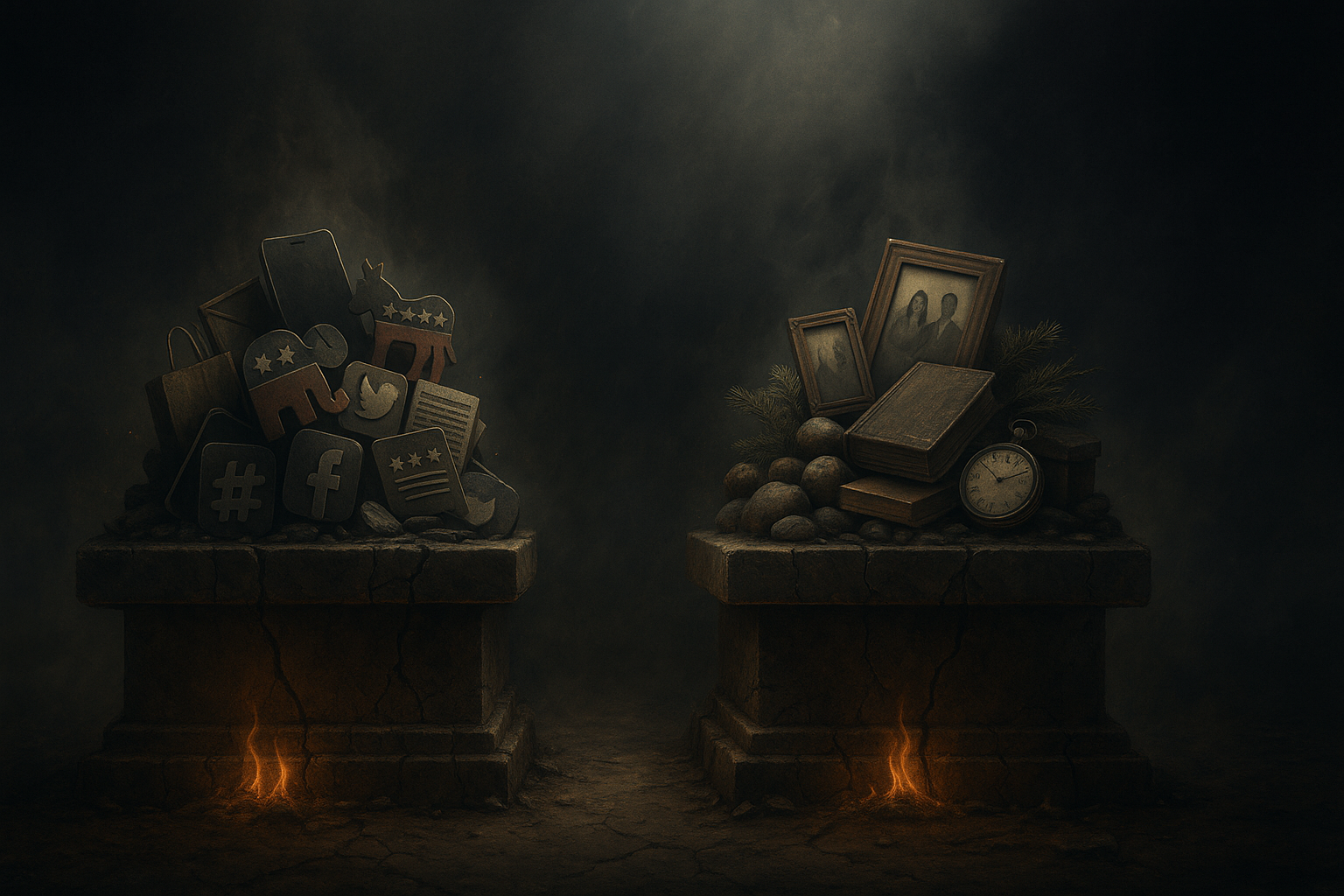
The trade off looks something like this:
The left worships at the altar of self-expression and unlimited autonomy. The right worships at the altar of tradition, heritage, and legacy.
Different altars, same problem—Christ is still not at the center.
The Covenantal Answer: Life Beyond Legacy
The Word of God speaks of something infinitely greater than legacy.
Every secular worldview, philosophy, or man-made religion, is built on human effort. They offer you the same basic deal: make your mark, live well, and hope it's enough.
But Christianity makes a claim so radical, so audacious, that it stands utterly apart: it doesn't offer you memory. It offers you resurrection.
Not an improved version of earthly life, but eternal life with the living God. Not a place in family stories, but relationship with the Creator Himself.
From the beginning, humanity was never designed to "live on" through nature or legacy. We were created for covenant relationship with the eternal God. Adam and Eve walked with God in the cool of the day—not as isolated individuals trying to make meaning out of the dirt, but as covenant partners with the Creator of all things.
When they sinned, it didn't just damage our relationship with God—it shattered our understanding of what it means to truly live. We became mortal, yes, but more tragically, we became spiritually dead, "alienated from the life of God" (Ephesians 4:18). The greatest consequence of the Fall wasn't physical death but separation from the One who is life itself.
The Gospel: More Than Moral Reform
Ryan's message is essentially a call to moral reform—to live better, more grounded lives. But the gospel of Jesus Christ isn't primarily about moral reform, but about resurrection from the dead.
"If in Christ we have hope in this life only, we are of all people most to be pitied" (1 Corinthians 15:19).
If Christianity is just a system for living a good life that ends in death and a potential legacy, then it's worthless. It's no better than stoicism or any other human philosophy. But the gospel announces something radically different.
The problem wasn't that you needed a more meaningful life. The problem was that you owed a debt you could never pay. You stood guilty before a holy God, condemned by His law, and deserving His wrath. You needed a substitute. Someone to live the perfect life you couldn't live and die the death you deserved to die.
Christ stepped into that role. He didn't come to give you tips on living well. He came to stand in your place.
On the cross, the Great Exchange happened. God took your sin—all of it—and placed it on Christ. And God took Christ's perfect righteousness and credited it to you.
"For our sake he made him to be sin who knew no sin, so that in him we might become the righteousness of God" (2 Corinthians 5:21).
On the cross, justice was satisfied. Not by you trying harder. Not by you building a legacy. But by Christ absorbing the full weight of God's wrath in your place.
This is why the resurrection matters. Jesus didn't stay dead. He conquered death itself. And because He lives, everyone united to Him by faith will live also—not metaphorically through memories, but literally and eternally through bodily resurrection.
The Resurrection Body: Real and Physical
The Christian hope is not that we "live on" through those who come after us. The Christian hope is resurrection.
This is the central claim of Christianity: the same power that raised Jesus from the tomb will raise us. We will have physical, glorified bodies in a renewed creation. We won't be disembodied spirits or vague memories. We will be more fully human, more fully alive, than we've ever been.
Ryan is right to emphasize family. But he's thinking too small.
In the covenant of grace, God isn't just saving individuals—He's creating an eternal family. When you are united to Christ by faith, you are adopted into the household of God. You become part of a family that transcends death itself. The church is not a collection of religious consumers, but the family of God—a covenant community that will endure forever.
Christians, your earthly family is precious. But your true family is the church—the bride of Christ—and that family will never die.
Getting out in nature, grounding yourself—these are good things, but the Christian's hope is for a new creation—a recreation and restoration of the material world. A world where the tree of life grows again, where the river of life flows, where God Himself dwells again with His people (Revelation 22).
Ryan's message ultimately places the burden on you. Try harder. Live better. Make your mark. Be remembered. But the gospel says your standing before God does not depend on your performance. It depends on Christ's performance. You can't manufacture your own immortality through legacy-building. Christ has already secured eternal life for His people through His death and resurrection.
Your job is not to be remembered by men but to be known by God—and Christ is the only way.
The Tragedy of Almost-Truth
The danger of conservative secularism is that it gets close enough to the truth that it scratches the itch—but it never actually satisfies. You're left with the same gnawing emptiness, the same fear of death, the same haunting questions of whether any of this actually matters.
Yes, turn off the distractions. Yes, reject hyper-consumerism. Yes, love your family. Yes, enjoy nature. But don't stop there!
When you stop at nature and family and legacy, you've just found a more respectable way to avoid the real issue. You've traded the chaos of modern life for a quiet rebellion against God.
And in the end, both will kill you just the same.
What Really Matters
So, what truly matters, especially around the holiday season?
Yes, turn off the distractions. Yes, reject consumerism. Yes, love your family. Yes, get outside. But don't stop there. Hold your family tight and point them to the One who holds all things together. Get out in nature and worship the Creator who spoke it into existence. Build something meaningful but recognize that your only hope is being united to Christ, who makes all things new.
The most important question isn't "How will I be remembered?" The most important question is: Do I know the One who conquered death?
That's the only way you actually live on.