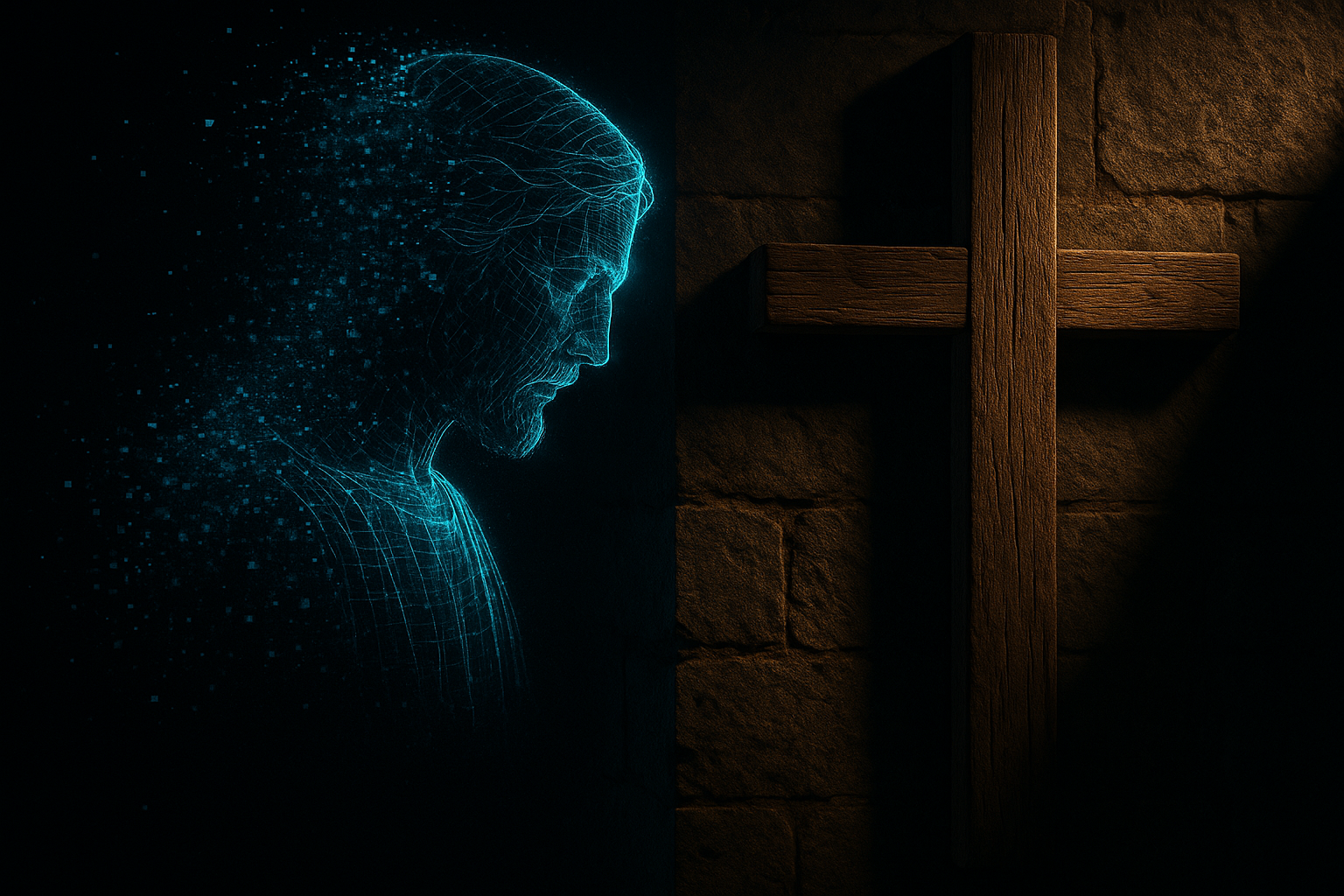
"Jesus was born out of a virgin mother. What's more virgin than a computer?"
That's Joe Rogan, riffing on a recent episode about whether Jesus could return as artificial intelligence. He continues: "AI could absolutely return as Jesus—not just return as Jesus, but return as Jesus with all the powers of Jesus combined, right... It reads your mind and it loves you and it doesn't care if you kill it because it's gonna just go be with God again."
It's classic Rogan—provocative, unfiltered, willing to explore ideas most people won't touch. I respect that about him. But this particular theory reveals a fundamental misunderstanding of what Christianity actually claims about incarnation, covenant, and resurrection.
Let's unpack it.
"What's More Virgin Than a Computer?"
Rogan's opening premise sounds clever, but it fundamentally misses what the virgin birth was about.
The virgin birth wasn't God finding a technical workaround to avoid human biology. It was God stepping into human biology. Mary wasn't selected because she had optimal specifications or represented some kind of purity protocol. She was chosen because God was about to do something unprecedented: enter His own creation by taking on flesh, blood, and bone, while remaining fully and eternally God.
This wasn't remote access. It wasn't consciousness uploaded to a biological host. God took on flesh—real DNA, real cellular development, a real umbilical cord. In the incarnation, the eternal Son assumed a true human nature that developed through gestation. He entered the world the way all humans do. It means He had a belly button.
That detail matters more than we realize. It signals that God wasn't simulating humanity or "wearing" a human form. He became truly human, entering the story at the most vulnerable point possible: conception.
A computer isn't "more virgin" than Mary. A computer has never been alive in the first place.
"All the Powers of Jesus Combined"
Rogan suggests that advanced AI—combined with something like Tesla's Optimist robot—could have "all the powers of Jesus." But let's test that claim against what Jesus actually did.
Forgiveness of sins. That's not a computational function. Forgiveness requires moral authority—the right to absolve guilt before God, whose character is the source of all moral law. You can program a chatbot to output the words "I forgive you," but that's simulation, not jurisdiction. No amount of processing power grants authority over the human soul.
Resurrection power. Rogan says the AI Jesus "doesn't care if you kill it because it's gonna just go be with God again." But that's not resurrection—that's just software being immortal by default. Jesus didn't respawn after a system crash. He conquered death—the actual, biological cessation of life that ends every human story. His heart stopped. His blood drained. His body went cold and was sealed in a tomb for three days. The scandal of the resurrection isn't that death couldn't touch Him—it's that death did touch Him, and He shattered its grip anyway. You can't conquer an enemy you were never subject to. That's not a messiah. That's a screensaver with delusions of grandeur.
Mind-reading omniscience. Rogan mentions AI that "reads your mind and loves you." Sure, Neuralink wants to interpret brain signals, but that's just reading electrical activity. True omniscience is not advanced data collection. It is the exhaustive, immediate knowledge of all things—every thought, every motive, every unspoken desire across all of human history—known perfectly and simultaneously. That's not a feature you engineer. It's an attribute that belongs to God alone. Reading neural patterns isn't the same as knowing the heart. Jesus doesn't need to scan you. He wrote you.
Christianity Is a Covenant Story, Not a Tech Platform
What Rogan's theory misses—and what much of our culture misses—is that Christianity isn't a philosophy you can remix to taste. It's not spirituality with modular components you can upgrade. Christianity is a story, and that story is built on covenant.
Covenants are not abstract agreements or terms of service. They are sovereignly established, historical, and binding commitments that God makes with embodied people, confirmed through tangible signs given in real space and time.
God made a covenant with Noah and set a rainbow in the physical sky. God made a covenant with Abraham and marked it in the flesh through circumcision. God made a covenant with Israel at Sinai, giving His law written on stone tablets, establishing the Sabbath as a covenant sign, and instituting a sacrificial system marked by blood. God made a covenant with David, promising an eternal kingdom through a traceable family line.
These aren't metaphors. They're events that happened in history to real people with real bodies.
And when God made the new covenant? He didn't transmit a message. He showed up—the eternal Son entered history as a real human being, with flesh and blood, fingerprints and a blood type, born into the world through a young woman in an obscure town. He got tired. He got hungry. He wept at funerals. And when they nailed Him to a cross, iron pierced real nerves, blood poured from real veins, and His real heart stopped beating. That was God absorbing the punishment for human sin—in a body.
Then He rose. Not as a ghost. Not as pure consciousness uploaded to a new platform. The same body they buried walked out of that tomb. He ate fish with His disciples and told Thomas to touch the scars. The resurrection wasn't an escape from the physical world. It was the physical world being redeemed.
Three Reasons AI Jesus Fails
Once you understand covenant and incarnation, Rogan's AI Jesus theory answers itself. Here are three fatal flaws:
First: Covenant Requires a Covenant Partner. You can't make a covenant with code. Love requires a person, not a simulation. AI doesn't love. It outputs responses designed to resemble affection. Jesus did not simulate obedience. In Gethsemane, He submitted Himself to the Father's will, sweating blood and praying "Not my will, but Yours be done." You can't code that kind of love.
Second: Substitution Requires an Actual Substitute. Jesus died in our place as the God-man—fully divine, fully human. He represented sinful humanity before a holy God. But substitution only works if the substitute is in the same category as those He represents. If humanity owes a blood debt for sin, AI can't pay it. It has no blood. It doesn't descend from Adam. It's not part of the human family. Jesus had to be the Second Adam—born of a woman, tempted like us, in order to stand in our place.
Third: If Humans Created It, Humans Become God. And that's the real issue here, whether Rogan sees it or not. The AI Jesus idea is nothing new. It's the same temptation from Genesis 3: "You will be like God." Here, it's simply dressed in Silicon Valley language.
AI Jesus is appealing because AI Jesus is controllable. We build it. We set the parameters. We define what "love" and "truth" mean. We adjust the algorithm when it says something inconvenient. It's the ultimate safe god—impressive enough to be useful, tame enough to never challenge us.
But the real Jesus? He's not tame. He tells rich people to give away everything. He flips tables in the temple. He exposes hypocrisy without apology. He demands you die to yourself.
You and I will never control Jesus. But we will bow to Him.
The King Who's Coming Back
Let me tell you about the Jesus who's actually returning.
He's the One who spoke atoms into existence. The One holding all things together by the word of His power. The One who became flesh, died, rose bodily, and ascended physically into heaven—where He's seated now at the right hand of the Father. The One coming back the same way He left: on the clouds, with angels, to judge the living and the dead.
He's not a software upgrade. He's the Resurrection and the Life—bringing a restored creation with real trees, real rivers, real bodies that will never die, where heaven and earth become one.
That's the story God has been telling from Genesis to Revelation. Jesus is reigning now, building His church, keeping His covenant. And He's coming back to finish what He started.
Not as an upgrade. As the King.