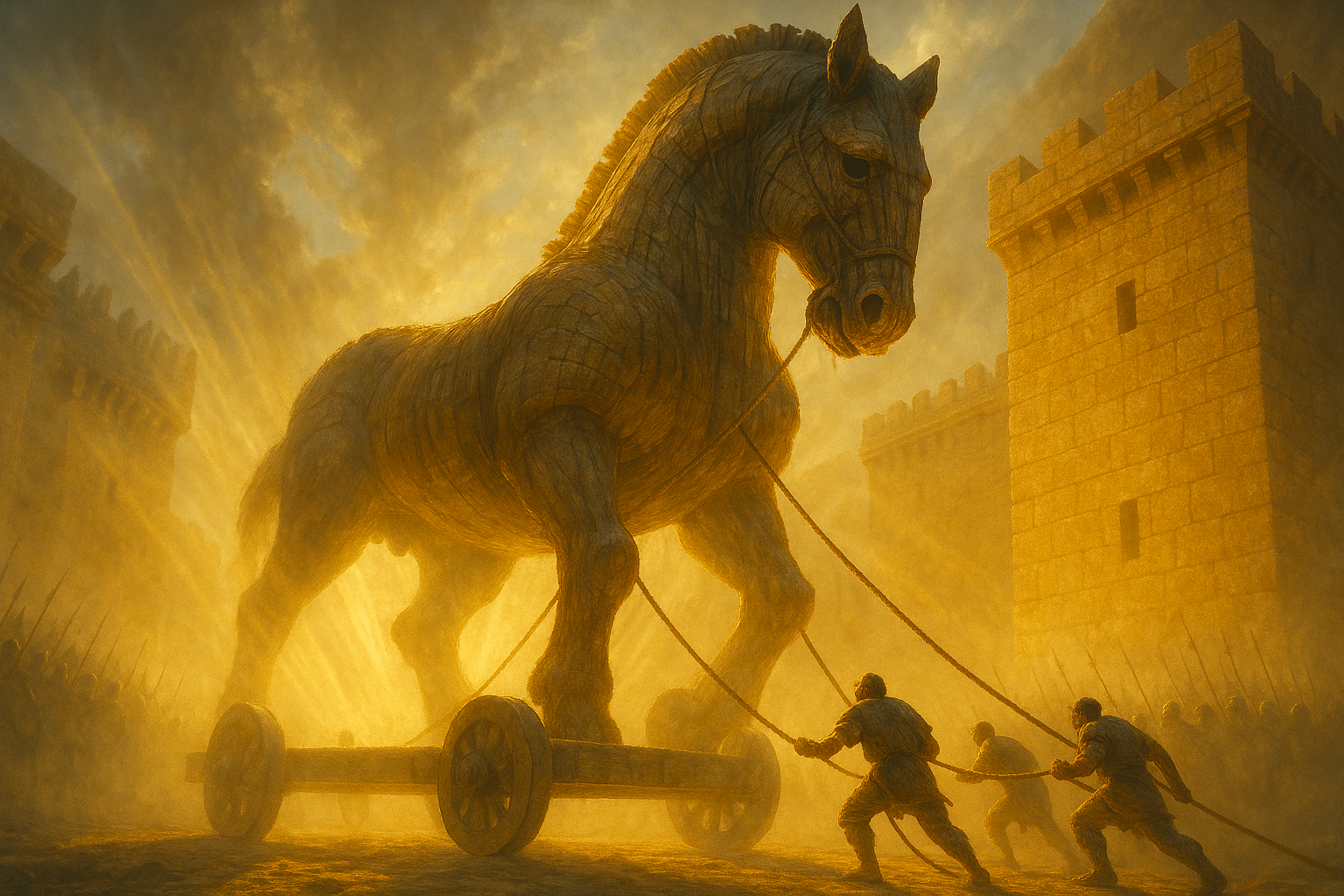

"So the Philistines fought, and Israel was defeated...And the ark of God was captured, and the two sons of Eli, Hophni and Phinehas, died." — 1 Samuel 4:10-11
The Ark was not stolen. It was sent. Those eight words overturn the way we remember this moment in Israel's history. The battle in 1 Samuel 4 does not look like God's plan unfolding. It looks more like collapse.
Israel is crushed on the battlefield. Thirty thousand bodies sprawled in the dirt. The priests are dead, their blood soaking into the same ground where they carried the Ark that morning. The camp is shattered. Men are running, screaming, stumbling over their own wounded as the Philistines sweep through like a wildfire.
And then, just when they thought the nightmare could not get worse, the unthinkable happens. The Philistines seize the Ark of the Covenant—God's throne, the place where His presence dwelt among His people—and hoist it onto their shoulders like war plunder. They parade it through the carnage, roaring in savage triumph, treating the holiest object in Israel like a common trophy.
Imagine you're standing in that field. Your hands won't stop shaking. Your boots slip in blood-soaked mud. Your lungs burn from panic as men you grew up with fall beside you. You hear neighbors screaming, dying slow deaths in the dirt. The priests who led you in worship last Sabbath—they're face-down in the carnage now. What do you see?
Defeat. Collapse. The end of Israel's story.
That's all you see—events spiraling out of control, prayers going unanswered, God's people crushed while God's enemies celebrate. The ground is still shaking beneath you. Your vision narrows to what's directly in front of you. The wider strategy is invisible. The commander's plan is out of reach. All you have is confusion, loss, that sickening sense that something has gone terribly wrong.
That's the trench.
What You See from the Trench
The trench is not just a position on the battlefield, but a way of seeing. A vantage point that feels clear but is actually the most limited perspective possible. And it's where many Christians live today. Close to the ground. Eyes fixed on the immediate. Interpreting Scripture through the narrow window of what's directly in front of them, never stepping back far enough to see the larger narrative those moments belong to. From the trench, every passage stands alone, every event feels disconnected, and life itself begins to feel like fragments rather than a single unfolding plan.
Picture a soldier in the trench, his face buried in the mud, trying to stay small while the world explodes around him. Smoke from the battle burns his throat. His entire world has shrunk to inches—mud, rocks, the trench wall pressed against his face. That's all he can see. Every sound threatens him, and every movement seems to push him back instead of forward. From where he's crouched, the battle looks hopeless.
But what he cannot see is the ridge where his commanders watch the entire field. He cannot see the war room where the generals have already planned for this exact moment, where his chaos on the ground is one deliberate piece of a larger operation. He sees collapse. They see strategy. And without the war room of Scripture, we see no more than he does.
What God Sees from the War Room
Christian, lift up your eyes. Step out of the trench and climb to the ridge. Look again. From the ridge, what looked like chaos begins to take shape. What felt random begins to form a pattern. Now climb higher still, into the war room of Scripture itself, where the entire battlefield of history spreads out before you under the sovereign hand of God. There you see a plan so precise, so wise, so intentional that even the darkest chapters reveal sovereign design. There you discover that God has never been caught off guard, never been outmaneuvered, never surrendered an inch of ground.
From the war room of Scripture, the full story comes into view. God created His image-bearers to live with Him, to walk in His presence, to enjoy the nearness of the King in the garden He planted for them. But in Genesis 3, humanity rose in mutiny against their King, and the fellowship they were created for shattered under the weight of their rebellion. The result was exile. They were driven from the garden, removed from God's presence, because a holy God cannot dwell in intimate fellowship with sin. That moment becomes the template. Exile is the consequence of rebellion. Distance from God is the judgment for covenant breaking. And that judgment reaches its final, most fearful expression in Hell, where separation from God's presence is complete, conscious, and eternal.
When God later formed the nation Israel as His people, entering into covenant with them, He made the pattern of exile unmistakably clear. The land was not only a gift but a new Eden, a place where God would dwell among His people once again, where His presence would rest in the midst of the camp and His blessings flow through their obedience. The terms were explicit. Through Moses, God declared that if they turned from Him, if they treated His presence lightly, if they broke the bond He established, they would be expelled from the land just as Adam and Eve had been cast out of the garden. Exile was the covenant's stated consequence, spelled out in Leviticus 26 and Deuteronomy 28.
But in 1 Samuel 4, something unexpected happens. Israel violates the covenant, treating the Ark of God like a lucky charm in battle, but they are not the ones driven out. The people who deserve exile remain in the land. Instead, the Ark goes in their place.
God Himself steps into the judgment they earned and enters the exile they should have faced, carrying the covenant curse into enemy territory. And there, in the land of Israel's enemies, the Warrior-King goes on the warpath. He unleashes His power and crushes the enemy His people could not defeat, without a single Israelite lifting a sword. Dagon is thrown down. The Philistines are undone. Judgment tears through their strongholds. Then God returns in triumph, carrying His presence back to Israel and restoring the fellowship their sin had shattered.
This is not a strange episode. From the trench, 1 Samuel 4 looks like nothing more than the Ark being stolen and later returned. But from the war room of Scripture, you see substitution.
God Himself provides a representative who steps into the place of His people to bear the covenant judgment required to bring the guilty back into fellowship. This is the pattern that begins in Eden, echoes through Israel, and reaches its fullness at the cross—where the true and greater Substitute enters the exile of death, destroys the enemies no human could conquer, and returns in resurrection victory to bring His people home to God forever. Hallelujah!
From the trench, the captured Ark is tragedy—it exposes Israel's guilt and looks like total collapse. But from the war room, you see the truth: the Ark enters enemy hands because God sends it there. What appears to be defeat is actually foreshadowing. God was not losing ground. He was advancing His kingdom.
What appears to be defeat on the battlefield of 1 Samuel 4 is the story of Penal Substitutionary Atonement unfolding in God's war room.
Where Are You Reading From?
So do not stay in the trench. Do not read Scripture or your own life from the narrow ground of the moment. The trench will try to convince you that defeat is imminent, that the story is slipping, that the battle has turned against you. It shows you noise, confusion, setbacks, and losses, but rarely the sovereign design moving beneath them. The trench gives you inches when you need miles.
Christian, lift up your eyes. Read the Bible the way it was written. Read it through the whole story that begins in Eden and moves through covenant after covenant until it reaches its fulfillment in Jesus. From that vantage point, scattered pieces hold their place. Patterns emerge. Purpose takes shape. You discover that God has never taken a single step in retreat. What appears like defeat from the trench is the precision of kingdom advance.
The Ark entering Philistine hands was tragedy, but it was a tragedy God wrote into the story to reveal the pattern of substitution that would reach its fullness at the cross. What looked like loss was actually the shape of victory.
The same is true for your life.
What feels like setback may be the kingdom advance you cannot yet see. What feels like silence may be God positioning pieces on the board. What feels like defeat may be the opening movement of a victory already secured in the war room of eternity.
So get out of the trench. Climb to the ridge. Step into the war room of Scripture where the entire battlefield of history spreads before you under the sovereign hand of God. There you will see what has always been true: God has never been caught off guard, never been outmaneuvered, never surrendered an inch of His kingdom. There you will find the Author of the story reigning on His throne—writing every chapter, orchestrating every scene, moving every piece toward the day when Christ returns to make all things new.
Read your Bible from the war room. Read your life from the war room.
And when the ground shakes beneath you, when chaos fills your vision, when you're tempted to believe the trench—remember 1 Samuel 4. Remember that what looks like the Ark being stolen is actually God bearing the curse, crushing the enemy, and bringing His people home.
The war room reveals what the trench can never see: your King is winning. He has always been winning. And He will not stop until every enemy is under His feet and every one of His children is safe in His presence forever.